|
|
GWR Route: Banbury to Wolverhampton
GWR Route: North Warwickshire Line
Birmingham Snow Hill Station: gwrbsh1130
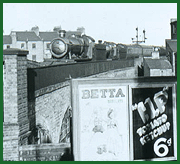
A workman stands amongst the debris on Platform 5 on the
morning of the 10th April 1941 following the largest air raid suffered by
Birmingham during the Second World War. The attack was one of many to hit the
city but this was the heaviest and a total of 1121 people were killed. Due to
its vast industrial capabilities and resulting importance to the war effort,
Birmingham was to be a major target for the German Luftwaffe bombing offensive.
Birmingham was the third most heavily bombed city in the country and prolonged
and powerful attacks destroyed many houses, factories, churches, and other
buildings. At the time government censorship meant such raids were not to be
highlighted by the media.
The editor of the city's Evening Mail explained to his
readers that: 'the experts, time and again have assured us that the publication
of detailed particulars regarding air damage would be slipping a useful card
into the enemy's hands'. The effectiveness of the censors may have resulted
from their understanding of Birmingham's importance to the nation's war effort.
With the city and its people in great danger, the responsibility of their
protection fell to the local Air Raid Precaution (A.R.P) services. Far away
from the battlefields of Europe, North Africa and the Far East, there were many
sacrifices on Birmingham’s home front. Enemy bombing destroyed at least
12,000 homes. 2,241 people lost their lives in the air raids and more than
3,000 people were seriously injured.
The image of damaged and wrecked buildings shown here serve
as stark reminders of the dangers faced by the people of Birmingham. Thousands
of volunteers answered the call to join Birmingham’s A.R.P. services.
These men and women were well trained and organised, and were prepared to risk
their lives in order to protect the safety of others. Despite shortages in
resources, Air Raid Wardens, the Auxiliary fire service, the Women’s
Voluntary Service and the Casualty Services worked day and night to protect the
city. Even children had a role to play, with boy scouts running messages in
between control posts.
 back back
|


 Donate
 Facebook
 Search