|
|
 |
|
|
GWR Route: Banbury to Wolverhampton
GWR Route: North Warwickshire Line
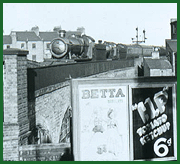
Birmingham Snow Hill Station: gwrbsh1131
 |
View of the damage to the buildings on Platform 1 showing
the ladies waiting room and the book stall which had been completely destroyed
in the air raid in the night of 9th/10th April 1941. There were many acts of
heroism during the the attack on the city that night including that of Sergeant
PH Bermingham (sic) of the 5th Birmingham Battalion (later 25th Warwickshire
(Birmingham) Battalion) who received the King's Commendation for Brave Conduct.
His citation read 'This NCO showed great courage and devotion to duty on the
night of 9th/10th April 1941. During an enemy air attack the factory which he
was guarding was hit by high explosive bombs and caught fire. Although the raid
was still in progress he played a prominent part in the evacuation of 400 work
people from the building. In spite of the fact that the building was by this
time ablaze and beginning to collapse, he broke his way through to the armoury
and recovered and brought to safety all the arms and ammunition of his Home
Guard unit.' Courtesy of the Home Guard.
Birmingham's industrial effort The fact that the Luftwaffe
was unable to knock out the Royal Air Force in the Battle of Britain owed much
to the workers of the Spitfire factory in Castle Bromwich. By the end of the
war, they were producing 320 Spitfires and 20 Lancasters a month - more
aircraft than any other factory in the UK. The array of war work in Birmingham
was staggering, and if the factories had been destroyed, the air force would
have suffered a mortal blow. When the BSA (Birmingham Small Arms) was hit badly
in November 1940, Churchill himself was alarmed at the consequent national fall
in the making of rifles. Birmingham firms were making everything from tools to
radio components, and by 1944, 400,000 Brummies were involved in the war in
different capacities. Courtesy of the BBC.
 back back
|
|
|


 Donate
 Facebook
 Search