|
|
GWR Route: Banbury to Wolverhampton
GWR Route: North Warwickshire Line
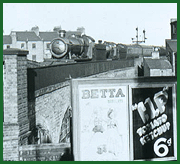
Birmingham Snow Hill Station: gwrbsh1168
View of Platform 11 looking towards Wolverhampton with two
Railcars standing in the bay platforms 9 and 10 on the left. In 1933, the Great
Western Railway introduced the first of what was to become a very successful
series of railcars, which survived in regular use into the 1960s, when they
were replaced with the new British Rail "first generation" type diesel multiple
units. The original design featured 'air-smoothed' bodywork, which was very
much the fashion at the time. The rounded lines of the first examples built led
to their nickname: "flying banana". The 'W4W' preserved at Swindon Steam
Railway Museum is an example of the original, rounded body shape. Later
examples had much more angular and practical bodywork, yet the nickname
persisted for these too.
The body of the first prototype was broadly based on the
popular 'Flying Hambuger' diesel unit of Duetsche Reichsbahn, but after wind
tunnel tests were carried out at the Chiswick laboratory of the London
Passenger Transport Board, the body was transformed into a sleek streamlined
design with a waisted fontal area. The success of Railcar number 1 prompted the
Great Western to place an order with AEC for a small series of six railcars in
February 1934, the same month that number 1 entered regular service. A number
of improvements in the design was made on this series, the largest of which was
the instalment of two AEC 8.85 litre diesel engines raising the maximum speed
to 80 mph.
The first three units, numbers 2 to 4, were to be fitted
with a buffet bar for use as an express businessman's service between
Birmingham and Cardiff, but no decision could be made on the body of the last
three and so construction of these bodies was held over for the time being. The
underframes and power units were again built at AEC under the direction of CF
Cleaver with the bodies built by Park Royal. To assist with oil temperature
control, the sumps of the engines were enlarged and fitted with cooling fins.
Unusually, the bogie's were both gear-driven and directly-driven in that only
one gearbox was fitted that powered both bogies at one end of the railcar,
while the other engine directly-drove just one bogie at the other end. The
fluid flywheel provided on this engine was designed to slip until full throttle
was required in top gear.
The interior design of these three railcars moved away from
the bus inspired design of number 1, especially with the inclusion of a buffet
and removable tables. The buffet could provide hot and cold drinks and wines
and a small amount of hot foods and snacks. A gas-heated boiler fed the coffee
and milk boiler and toaster, while nearby was a small toilet with hot water
heated by the engines exhausts. The first of the series was delivered in early
July 1934 and underwent several trail and press runs before entering service
with the other two members on the 16th of July. This service was the first
regular diesel working to be run to a fast schedule in this country and the
117½ miles between Birmingham and Cardiff were covered in 2 hours 20
minutes. Fares were charged at the normal 3rd class pricing but bookings were
limited by the number of seats on the railcar. Courtesy 'The Great
Western Archive'.
 back back
|


 Donate
 Facebook
 Search