|
|
GWR Route: Banbury to Wolverhampton
GWR Route: North Warwickshire Line
Birmingham Snow Hill Station: gwrbsh1176
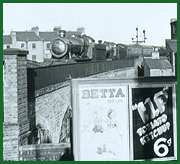
With not a passenger to be seen, a view of a practically
deserted Snow Hill station as a consequence of the rail strike by ASLEF members
in May 1955. The 1950s saw Britain's economy ravaged by industrial action
across most sectors and the railway industry was no exception. An expanding
economy after the Second World War resulted in the railways being affected both
by road competition and competition for workers. The better hours, wages and
working conditions found in the engineering and manufacturing sectors resulted
in many workers to leave. The British Transport Commission had therefore tried
to increase wages for the average railway worker who was represented by the
National Union of Railway workers but this affected the differential between
them and footplate staff represented by Associated Society of Locomotive
Engineers and Firemen.
The following is an extract from Hansard, the Journal of the
Houses of Parliament, of VISCOUNT WOOLTON's speech. "My Lords, with your
permission, I should like to read a statement which my right honourable friend,
the Minister of Labour and National Service, is making at this moment in
another place".
He says: "As the House knows, on the 16th April the
Associated Society of Locomotive Engineers and Firemen, the union which
represents the bulk of the footplate men employed on the railways, announced
their intention of calling their members out on strike as from the 1st May, in
protest against the award of the Railway Staff National Tribunal which was
announced the previous day. This award has the effect of confirming an
agreement providing for general increases in rates, including increases for all
footplate grades, which had been reached between the British Transport
Commission and the National Union of Railwaymen, to apply from 10th January. It
resulted, however, in a narrowing of the differentials for all footplate men
arising from last November's award of the Tribunal. The sums involved are
comparatively small (ranging from 1s. 6d. to 5s. 6d.), and the Society's case,
as their representatives have made plain to me, is based not on any claim of
hardship, but on their concern to prevent any shrinkage in existing
differentials enjoyed by the footplate grades.
"The decision to strike involves throwing overboard the
award of the industry's own Tribunal confirming an agreement to which the other
union involved, namely the National Union of Railwaymen, is a party. That union
has men in every grade concerned. "In these circumstances I did not feel able
to intervene. As the issue had already been before the industry's own Tribunal,
I could not set up an independent body, such as a Court of Inquiry, to look
into it. Nor could I invite the British Transport Commission to reconsider the
footplate men's 616 rates, as this would involve jettisoning an agreement which
the Commission had concluded with the National Union of Railwaymen and which
had been confirmed by the Tribunal. I have seen the Chairman of the British
Transport Commission, who takes the view that the agreement and award should
stand. "The Trades Union Congress, with which I have kept in close touch
throughout, has been giving much consideration to the dispute. Their
appropriate Committee has been in touch with the Society.
I have this morning received a notification from the
General Council of the Trades Union Congress, of a resolution in the following
terms: ‘'That the General Council'—’ of the T.U.C.—
‘'ask the Minister of Labour to arrange a meeting of representatives of
the British Transport Commission and the Associated Society of Locomotive
Engineers and Firemen, with the object of discussing the possibility of ending
the present deadlock.'’ "In response to this request, and in view of the
widespread unemployment and dislocation of our national economy which would
result from a railway stoppage, I have thought it right to invite the
Commission and the Society to take part in discussions at my Ministry during
this afternoon. These discussions, of which I am quite unable to predict the
outcome, are about to take place. I am sure that in these circumstances the
House would not wish me to add to my statement at this stage." I thought it
would be convenient to your Lordships to hear that statement now.
 back back
|


 Donate
 Facebook
 Search