Warwickshire Railways: Book Review
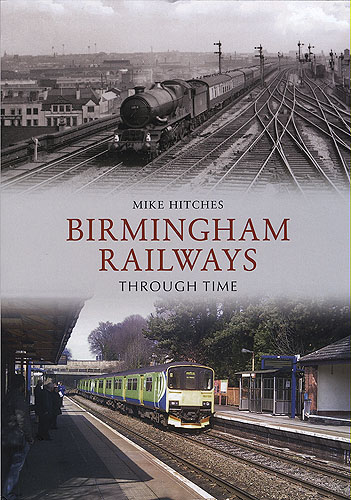
Birmingham Railways Through Time
The Through Time format is a popular concept
essentially a variation of the before and after genre. There are 150 plus
titles in the Through Time (TT)format from Amberley Publishing,
primarily focused on a specific location, which demonstrates just how popular
this format has become. The most obvious difference between the Through
Time format and the Before and After genre is that the Before
photographs are printed in sepia and not black and white. Mike Hitches would be
known to visitors to our website because of his book Warwickshire
Railways which effectively covers the county using same time line as our
website.
Unfortunately given the pedigree of both the publisher and
the author this book is a bit of a curate's egg. There is no doubt that given
the size of Birmingham, and therefore the large number of stations and other
structures that once existed, this was going to be quite a challenge. To keep
to the publisher's proven Through Time format the author would need to
balance geography, time and relevance to make a success of this book. There is
also the added complication that railways operate along given routes and
therefore any historical record needs to be set out logically and follow either
what was or is still in-situ on the route in question. Unfortunately the author
has failed on all four accounts.
The first thing to note is the complete absence of a route
map or contents page which makes navigating the through the book difficult. I
suspect that the inclusion of either would have immediately demonstrated the
shortcomings of the book. The book is unbalanced geographically with much less
coverage of the routes to Derby, Leicester and Lichfield and altogether fails
to mention the Harborne Railway. The GWR is well represented to the south of
the city and so is the MR, in part (however Selly Oak, Kings Norton and
Northfield and the later University stations are ignored). One suspects that
the dearth of easily available material on the northern routes might be one of
the reasons for the geographical imbalance.
It must be a great challenge to authors using the TT
or Before and After format to record railway stations and other scenes
which have long disappeared. Where existing stations still exist Birmingham
Railways Through Time uses the before and after format to record the
changes over time. Where new stations or now long gone facilities such as
Saltley shed are illustrated these are illustrated by a set of photos without
reference to previous or current scenes. Commendably, the author recognises
that there are more to Birmingham's railways than the GWR, LNWR and MR by
including some industrial locations. However the number of photographs employed
to show the Cadbury and Longbridge industrial railway systems only emphasises
the dearth of material elsewhere. In addition, they are often not relevant to
the title of the book Birmingham Railways Through Time. A photograph of
a Cadbury's poster, multiple images of Longbridge's shunters and the derelict
works together with photographs of the redevelopment of the site makes poor use
of the limited space available.
The use of sepia photographs to show the then scene
is a clever concept but for me, a railway enthusiast, it fails to work as I
associate sepia photographs with Victorian and Edwardian photographs and not
Class 87s passing through Birmingham International station. Incidentally, if
this format had been correctly followed then the colour photograph of the
ex-LMS 4-6-2 Princess Coronation Scot No 46235 'City of Birmingham'
standing in Birmingham Science Museum in 1990 should have been a sepia
photograph. There is also an issue about the quality of the colour photographs
used within the book. It has to be said that they are sometimes indifferent in
terms of quality and subject matter and in my opinion there is no excuse for a
blurred modern image photograph, even of a train passing at speed. Either buy a
better camera or omit the photograph.
If the author had been systematic in his approach to writing
and composing this book then he would have realised that the TT format
was not appropriate to the subject matter covered by the title, primarily
because the amount of material to be included to give justice to Birmingham's
railways is just too great. As the publisher has produced other railway titles
following a different format and so too has the author, its difficult to
understand why this format was chosen.
Whilst there are some good photos not seen by myself
previously, this book is very much a mixed bag which would probably only
satisfy people new to the Birmingham railway scene and or hold specific
geographic interests. Mike Musson
248 x 172 mm, 192 pages with 180 Colour and Sepia
Illustrations
ISBN 9781848686540
RRP £14.99 Special Offer £13.49 and free
UK shipping if ordered direct from
Amberley.
 back back

|

 ·
LMS ·
GWR ·
LNER ·
Misc ·
Stations ·
What's New ·
Video ·
Guestbook ·
About
·
LMS ·
GWR ·
LNER ·
Misc ·
Stations ·
What's New ·
Video ·
Guestbook ·
About